The Curse of Salvation

The Curse of Salvation

Wednesday, 16 February 2022

THE UNSUNG SPEAKER’s BURDENS: HIS/HER ROLE AS PARLIAMENT’s SPOKESPERSON


The events pertaining to former Speaker Job Ndugai’s resignation, and the process leading to Speaker  Tulia  Ackson’s   election  to  that  position; were  altogether  an  entirely  new  experience  to  many  of  our  people. This is because the last time such events occurred in our jurisdiction  was   in 1994,  nearly  thirty  long  years  ago. Hence, understandably, these “novel” events stimulated some   animated   discussions   among the interested members  of  the  public;  and  I  was  asked  several  times  by  the  media  to  comment  on,  or clarify,  some  of  the  issues  involved  in  connection  therewith,  particularly  those   relating  to  the Speaker’s “meagre” election qualifications, and  his/her leadership  roles.  And I responded by doing the needful, in   several articles published in this column.  
  However, because of limited editorial space allocations, I could not cover some of   the more important aspects; such as the question of the “Speaker’s burdens”; which  include  that  of  “defending  Parliament’s  decisions”.  I have thus decided to make that issue the subject of today’s article.
   The relevant   background.
The British Parliament, the House of Commons, still   maintains a tradition, which started at a time in its history, when the relations between Parliament and the Monarch were  toxic,  and  extremely   antagonistic. Thus, because the Speaker had the duty of conveying certain Parliamentary resolutions to the Monarch, an irate King, who was opposed to  such  resolutions,  could   demonstrate  his  anger  by  ordering  the  Speaker’s   punishment,  for  the ‘crime’  of  bringing  such  ‘treasonable ‘   messages  to  him.   Hence,  in  view  of  that   lingering  danger,  there  developed a  tradition  for  the  person  who  was  elected  to  the  position  of  Speaker,  to  make  a  token  show  of  reluctance  in  accepting  that  office,  as  a  demonstration  of   fear  for  the  consequences  involved;  whereby    every  newly  elected  Speaker  of  the  House  of  commons  had  to  be  literally ‘dragged’  to  the  Speaker’s  Chair,  in  a  mock  little  ceremony.                                                     
        This ‘dangerous’ role of the Speaker   is what I have referred to in the heading of this article, as the  “unsung  Speaker’s  Burden”.  In this context, the word “burden” means ‘responsibility that causes worry, or difficulty”. Thus,  in  pursuance  of  that  responsibility,   in  February  2004,  I  published  an  article  titled  “In   the   defense  of  our  Parliament” ;   which  was  published  simultaneously   in  two  local  English  language  newspapers,   the  Daily  News,  and   The  African,  on  26th  February,  2002,   commenting  on  a  judgment  by  the  Court  of  Appeal  of  Tanzania,  in  the  case  of  Julius  Ishengoma   Francis  Ndyanabo  vs  Attorney  General;   delivered  in  Dar es  Salaam   on  14th  February, 2002;    in  which  the  court  held  that:   “Parliament  exceeded  its  powers  by  enacting  the  unconstitutional  provision”.                                                 
    This is precisely the point which prompted me, as the Speaker, to defend Parliament’s decision in that regard. But surprisingly, that article raised a ‘hue and cry’ from some obviously   uninformed gentlemen members of the media.  One Kiswahili newspaper carried a front page headline with the malicious wording:‘MSEKWA  AWASHAMBULIA  MAJAJI”,  which  was  a deliberate  and   mischievous  misrepresentation  of  the  facts.                      
        And  another  attack  came   from   the  Tanganyika  Law  Society ,  which  responded  (like  the   irate  King  in  the  story  of  the  British  tradition  narrated  above),  by  publishing   its  own  misconceived  statement,  describing  my   article  as  an ‘assault  on  the  Judiciary’,  and  falsely   attributed  to  me  certain   words  that   I  had  not  said  in  my  article! For example, they falsely claimed that I “had challenged the decision of the Court of Appeal”; when, in fact, I had stated clearly therein, that “the offending provision is surely dead and buried”.                                               
        They also falsely claimed that I had “challenged the power of the court to make that decision”; when, in fact, I had   fully acknowledged the power  of  the  courts  of  competent  jurisdiction   to  make  such  decisions,  by  quoting  the  1984  constitutional   amendments  which  gave  them  that  power. As the incumbent Speaker at the material time, I was only carrying out my responsibility of defending Parliament’s decisions.                     
         This is what I said: -Basically, I raised the following   three “points of order” in that submission.  One, that Parliament did not exceed its powers in enacting that legislation. In support of that assertion, I made reference to the High Court judgment in the case of Rev Mtikila vs Attorney General, (TRL 31); in which the  High  Court  of  Tanzania  magnanimously  acknowledged  the  wide  extent  of  parliaments  legislative  powers,  even  in  respect  of  the  Constitution itself.  The High court had held that “our Constitution confers on Parliament very wide  powers  of  amendment;  but  they  are   by  no  means  unlimited. These   powers   are to be found in article 98 (1) and (2).  They are evidently wide, for in the first place, Parliament has   power to amend even those  provisions  providing  for  basic  human  rights.               
    Secondly, that   power is not confined to a small sphere.  It extends to modification of those provisions; their suspension or repeal and  replacement;  or  re-enactment  or  modification  in  the  application  thereof”
        Two, an admission that the inherited British concept had been substantially been   modified and qualified by   article 64 (1) of  our  Constitution,  which  confines  Parliament’s  legislative  powers  only  to  matters  that  are  specifically  stated  therein.
        Three, that this   court had   unfairly ignored the Latimer House Guidelines for the Commonwealth” on ‘the relationship between  Parliament  and  the  Judiciary’;  which  provides  that  “the  legislative  function  is  primarily  the  responsibility  of  Parliament,  as  the  elected  body  representing  the  people.  Judges may be constructive and purposive in the interpretation of legislation but  must  not  usurp  Parliament’s  legislative  function. 
    Courts have the power to declare legislation to be  unconstitutional,  However,  the  appropriate  remedy  should  be  for  the  court  to declare  the  incompatibility  of  a  status  with  the  Constitution,  leaving  it  to  the  Legislature  to  take  remedial  legislative  measures”.
    Four, that this court had also unfairly ignored the “intention  of  the  Legislature”  in  enacting  this  legislation;  which  was  ,firstly,   to  avoid  vexatious  or  frivolous  petitions;  and  secondly,  to  ensure  that  the  respondents  in  election  petitions  are  protected  in  terms  of  costs  which  they  are  forced  to incur  in  defending  their  cases.  But alas, in spite of these  cogent  arguments,  I  became the  victim  of  attack  by  the said   “irate  Kings”.
  An abbreviated version of that article.
        “On  14th  February,  2002;  the  Court  of  Appeal  of  Tanzania  delivered  its  judgment  in  the  appeal  case  of    Julius  Ishengoma  Francis  Ndyanabo  vs  Attorney  General;    in  which  the  court  held  that  section  112 (2)  of  the  Elections  Act,  1985  (which  requires  a  deposit  of  shillings  five  million  to  be  made  by  a  petitioner  in  an  election  petition,  in  order  for  his  petition  to  proceed  to  hearing),  was  unconstitutional.,  and  was  consequently  struck  out  of  the  statute  book.  But the Court of Appeal held further, that “Parliament had  exceeded  its   legislative  competence  is  limited  to  making  laws  which  are  consistent  with  the  Constitution”.  
        The question of Parliament exceeding its legislative powers.
Article 64 (1) of the Constitution of the United Republic of Tanzania, 1977; provides that: “Legislative power in relation to  all  Union  matters,  and  also  in  relation  to  all  other  maters  which  are  not  Union  matters  concerning  Mainland  Tanzania,  is  hereby  vested  in  Parliament”. As in many other cases, this provision was inherited from the then British concept, that “the  legislative  authority  of  Parliament  over  all  matters  and  persons  within  its  jurisdiction  is  unlimited.  A law might be unjust or contrary to sound principles of governance, but when it erred, its errors  could  only  be  corrected  by  itself”.   
     However, new developments that took place in the twentieth century, led Parliament to accept that its unlimited legislative  powers  should  be  qualified. But,  perhaps  unwittingly,  the  previous  British  concept  of  Parliament’s  legislative    supremacy  was  transferred  to  Tanganyika   in  its  totality  at  the  time  of  the  country’s  independence,  through  its  inclusion  in  both  the  Independence  and  Republican  Constitutions  of  1961  and 1962  respectively;  and  is  reflected  in  Mwalimu  Nyerere’s  in  the  House  on 28th  June,  1962  when  he  said  the  following:-  “This  Parliament  can  make  any  law.  For example, it has power to pass a law, which provides that no one in  Tanganyika  should  have  the  right  to  vote,  except  bachelors  and  polygamists.  They have the constitutional power to do so; but our MPs will certainly not  do  that;    simply  because  they  are  not  insane.  There is a distinction between the availability of given powers, and the practical use of  such  powers”.                                                                                              The Latimer House Guidelines.
These  Guidelines  were  drawn  up  and  approved  at  a  meeting  of  Representatives  of the  Commonwealth  Parliamentary  Association; the  Commonwealth  Magistrates’  and  Judges’  Association;  the  Commonwealth  Lawyers’  Association;  and  the  Commonwealth  Legal  Education  Association;   which  was  held  at  Latimer  House  in  the  United  Kingdom,  from  15th  to  19th  June, 1998;  which  adopted  the  resolution  that  was  quoted  above;  which  requires  the  courts,  in  the  relevant   cases,  “to  declare  the  incompatibility  of a  statute,  leaving  it  to  Parliament  to  take  the  remedial  legislative  measures”.  
        And in the  case  of  Tanzania,  this  guideline   was  actually  implemented  through  the  constitutional   amendments  which were  made  in 1994  to   by   article  30 (5)  of  the  Constitution  of  the  United  Republic;  which  prescribe  the  procedure  to  be  followed  where  the  court  of  competent  jurisdiction  considers  that  Parliament  enacted  legislation  which  is  in  conflict  with  the  Constitution,  aa  follows:- “Where,  in  any  proceedings  it  is  alleged  that  any  law  enacted  abrogates  or  abridges  any  of  the  basic  rights  set  out  in  this  Constitution,  the  court  is  satisfied  that  the  law,  to  the  extent  that  it  is  in  conflict  with  the  Constitution  then,  instead  of  declaring  that  such  law  is  void,  shall  have  power  to  afford  the  authority  concerned  a  opportunity  to  rectify  the  defect,  within  such  period  and  in  such  manner  as  the  Court  shall  determine”.  That   is when I posed the question:  why did the  noble  court  of  Appeal  fail,  or  perhaps  refuse,  to  adopt  this  procedure,  which  is  prescribed  by  the  Constitution  itself?
        It is worth noting, that in creating the said guidelines, the Latima House meeting also emphasized  that “the  successful implementation  of  these  guidelines  calls  for  a  commitment  made  in  the  utmost  good  faith  of   the  relevant  national  institutions,  in  particular  the  Executive,  the  Parliament,  and  the  Judiciary”.  In our case, both the Executive and the Parliament had done the needful in introducing the  constitutional  amendments  referred  to  above.                                               
        The decision by the court of Appeal to ignore these guidelines, provides a temptation for  people  to  assume  that  perhaps  it  was  lacking  in  its “commitment  to  the  utmost  good  faith”  that  is  required  for  the  proper  implementation  of  these  guidelines! And I concluded with a humble admission, that this article “was a   purely   intellectual exercise, for  it  is  clearly  of  no  effect  with  regard  to  the  Court  of  Appeal’s  decision.  
    The full story, that is to say, the court of Appeal’s judgment; my  published  article  commenting  on  that  judgment;  the  Tanzania  Law  Society’s  misconceived  statement;  and  my  rejoinder  to  that  Statement;  are  all   available  in  my  book  titled  “The  story  of  the  Tanzania  Parliament” (Nyambari  Nyangwine  Publishers,  Dar  es  Salaam,  2012).   
    The Speaker is not only   the Presiding Officer over the business of the House; he/she is also  its  spokesperson,  and  guardian  of  its  privileges. This story hopefully helps to ‘bring to light’ the   little  known  (unsung)  Speaker’s  burden  of  having  to  defend  Parliament’s  decisions  in  a  hostile  environment.
  piomsekwa@gmail.co   /0754767576.  
Source: Daily News tomorrow.                                                                                                                

Tuesday, 15 February 2022

Kenya Presidential Race: How and Where Ruto Goofed on Kenyatta

No doubt. Kenya’s Deputy President, William Ruto is in a political limbo if not hot soup. If we can make sense of President Uhuru Kenyatta’s open avowal to back his archnemesis, former PM Raila Odinga in the coming general elections. This makes Ruto’s dreams to succeed his boss in toto unactualizable. Again, whom to blame in the first place? Ruto is. Why? The following reasons speak volumes as to why Ruto won’t make it to the statehouse in the coming general elections.
        Firstly, Ruto goofed wrongly thinking that his political marriage with Kenyatta was the upshot of love. He however knew that this marriage of inconvenience was necessitated by the then looming ICC’s case the duo faced together. Maybe, he thought he’d outsmart or change Kenyatta before being outsmarted or shortchanged. Ruto knew that ganging up with Kenyatta won’t only provide an opportunity to take a stab at power but also would award and guarantee him support from the then government of Mwai Kibaki since Kenyatta was part of it. 
        And, indeed, Ruto survived by using Kenyatta. Maybe, this made Ruto wrongly believe he’d use Kenyatta to achieve his covert goals.  On Kenyatta’s side, he used Ruto to access Kalenjin votes. And this averted the duo the danger they’re temporarily facing together. Importantly, it’d be noted that Kenyatta didn’t like or love Ruto and vice versa. They’re just strange bedfellows. It was a strategy for survival since it didn’t only enable the duo to get assistance from the government but also awarded them presidency, which, though was Kenyatta’s but not for the duo.
        Provided that Ruto survived on Kenyatta’s back, he forgot that the duo wasn’t equal and the same. Neither was it in true love. Thus, he lacked patience and needed more. The sage has it that nothing should be done in a hurry except catching fleas. Instead of studying his boss, Ruto myopically lowballed him and started behaving as a co-president instead of deputy. This has its dangers. Presidency’s a pomp position that doesn’t want any interference or co-ownership. Refer to what happened when Kibaki and Odinga entered the GNU not to mention the neighbouring South Sudan. To survive, Ruto needed unflappability of living in the stupor under the wings of his boss. Had he done this, Ruto would now be grinning instead of  being grumpy.
        Secondly, Ruto needs to blame and curse his overconfidence that blinded him to view Kenyatta as the guy he’d easily use as a door to the statehouse. Kenyatta’s born a politician who grew up in political family. He also enjoyed the backing and tutelage of Moi and Kibaki. Ruto’s overconfidence deluded Ruto and thereby forgot that almost all Kenya’s presidents were supported by someone to get to power. Kenyatta senior was supported by Odinga Senior. Moi by Kenyatta Sr and Kibaki by Odinga Jr and soon Odinga Jr will be supported by Kenyatta Sr paying his father’s debt. Who’s Ruto to disturb this legacy and strategy?
        Thirdly, Ruto underestimated Kenyatta who’s smarter and more pre-emptive than Ruto. When he started acting as a co-president while he wasn’t, he forgot that nobody likes to share what’s his or hers otherwise doing so is for her/his advantage. In co-owning presidency, many things can happen. For example, what if the co-president seeks to dwarf another not to mention abusively using power to undermine another. By acting as a co-president, Ruto exposed himself, mainly when he started to be linked with venality and amassing wealth illegally. Failure to think that being a deputy president didn’t give Ruto automatic power of sharing power is the mistake he’ll forever regret. This is an albatross around his neck. It’s very hard to dispel or overcome. It becomes even harder when a tycoon like Ruto runs under the slogan of hustler that he realistically isn’t. This shows him as a con who seeks to hoodwink the majority of the Kenyan poor people. Sane people would want him to explain how he quickly amassed the alleged mammon.
        Fourthly, Ruto refused to learn from history, especially that of his mentor and cloner, Moi who tolerated many blitzes and degradation from Kenyatta’s inner circle. This assured Kenyatta that if anything would happen as it did, he or his family would be in safe hands. What Ruto did is to count chickens before hatching.
        Fifthly, Ruto failed to study Kenyatta’s decoys, namely caginess, clandestineness, unfussiness and wiliness. The sage’s it that wise men are never in a hurry. Kenyatta waited for the right moment to foray back, and he succeeded without any ado. So did Odinga. When Kenyatta pretended that he’s comfortable with Ruto’s behaving and thinking he’s co-president, Ruto bit a bait. Had it not been Ruto’s greed for power hurry and myopia, today, Ruto would have been preparing himself to succeed his boss. 
        Again, when Kenyatta said Ruto would succeed him after finishing his two term-presidency, Ruto’s blindly and pointlessly on cloud nine little knowing that a week in politics is a long time. Anything can change since Ruto failed to underscore the fact that humans are fickle. Who knew Kenyatta would back his archnemesis and dump his VP? Again, were Kenyatta and Ruto buddies or two enemies in the same bed?
Source: African Executive Magazine tomorrow.

Sunday, 13 February 2022

A season of hope – and fear


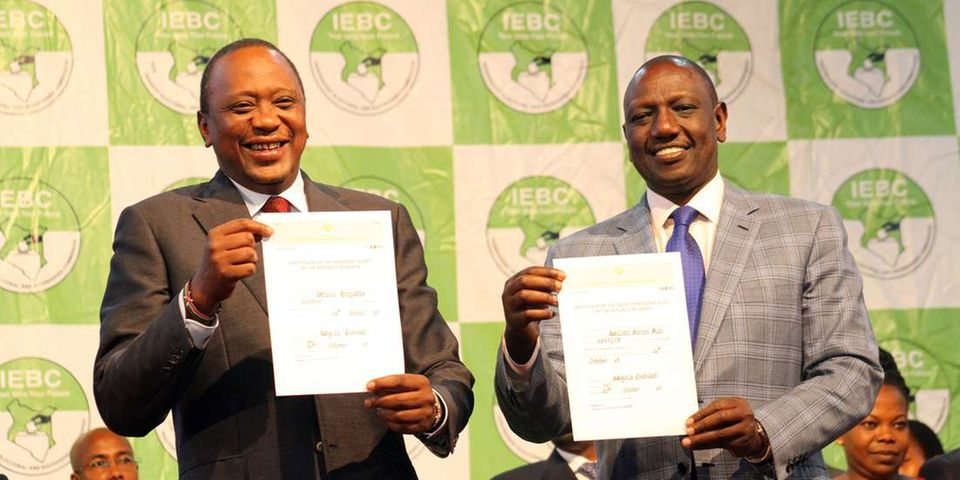
President Kenyatta and his deputy William Ruto display winners' certificates at the Bomas of Kenya on October 30, 2017 after IEBC declared the presidential election results. A close election is contestable, especially in the street, but a shellacking isn’t.

                      By Makau Mutua
Professor at SUNY Buffalo Law School and Chair of the KHRC.
On January 31, 2022, iconic cartoon artist Godfrey Mwampembwa – popularly known as Gado – took his pen to my visage in The Standard. 
His handiwork didn’t especially warm the cockles of my heart. But I suppose the cartoon would be pointless if it didn’t lampoon and mock me. That’s why free speech is a beautiful thing. I laughed out loud. However, the brilliant cartoonist had swung, and landed a big punch. I wasn’t quite sure whose noggin took the hit. Clearly, Gado was having fun at both my expense and that of ODM’s Raila Odinga. But it was the fiendishly menacing face – part hidden – in the crystal ball that caught my attention. Gado feared a titanic, if utterly Armageddon-like, clash.
        That’s why Gado’s cartoon of yours truly was a metaphor for what might – or might not – happen on August 9, Anno Domini 2022. Let’s hope this year won’t reprise 2007/2008, decidedly an annus horribilis. A truly stinking year if ever there was one in Kenya’s history as a republic. In that year, Deputy President William Ruto and Mr Odinga were on the same side of the political pitch. Ranged against them was PNU’s Mwai Kibaki and Kanu’s Uhuru Kenyatta.
Neutral observers
They say Mr Kibaki prevailed, but Judge Johann Kriegler, the wily South African jurist, demurred. Incredibly, against all available evidence, he said we would never know the winner. It was Solomonic, but bitter to neutral observers and supporters of Mr Odinga. There’s no doubt Mr Odinga was robbed – in broad daylight. The man they call Agwambo made peace with Mr Kibaki for the sake of Kenya and joined him in a unity coalition government. In that moment, no one could deny Mr Odinga was a towering statesman.
        Our country almost went to hell in a handbasket because of a stolen election. Some of our people summoned the devil in them and did unspeakable things. Countries and states can grow, or retard, from a cataclysm like that one. I would like to think though Kenya is a very noisy – and messy – fledgling democracy, it’s still the beacon of East Africa. Our laundry is dirty, but we democratically wash it in public.
        On August 9, Mr Odinga and Mr Ruto will be on opposite ends. The battle has been joined and the student has raised his scythe against his master. An intemperate and impudent understudy has threatened to upend those who know better.  Mr Ruto is clever, often by half. The man from Sugoi can look you in the eye and tell you the colour green is actually red. I often get the impression that he believes his own “alternative facts”. The headline going into August 9 is that Mr Ruto is dying to kick his boss in you-know-where. In Kiambu, the backyard of Jubilee’s Uhuru Kenyatta, Mr Ruto called his boss a pathetic dismal failure and laggard.
        I am dumbfounded that Mr Ruto has thrown all caution to the wind. He acts and talks as though he has nothing to lose. He seems to have a premonition that he’s going down. That’s why the claws are out. I still don’t get his strategy. He wants to pull off a palace coup against his boss, albeit at the ballot. It’s never been done in Kenya. Mr Odinga, on the other hand, has taken the high road. He’s the international statesman. His allies have projected him as the safe hands. He has shied away from brawling with his junior pupil. But how long can Mr Odinga hold fire? My guess is not for long. And he shouldn’t.
A latent fuse
As the teacher, Mr Odinga should take his pupil back to the classroom and give him a 101 in whooping. It will be good for Mr Ruto and make him a better person. But what Gado feared might also happen. August 9 could be a latent fuse. This is what I fear, and hope doesn’t happen. That’s why, even as Mr Odinga lacerates Mr Ruto going forward, he must do so with clean, if merciless, shots to the body. Nay, to the noggin. By the time August 9 rolls around, Mr Odinga needs to make sure Mr Ruto is punch-drunk. He must punch again and again, over and over until he brings him to the point of political surrender.
        What’s my point? My crystal ball calls for Mr Odinga to beat Mr Ruto with a convincing margin that any thoughts of lighting a deadly fuse akin to 2007-08 is unthinkable. That’s why Mr Odinga needs a formidable coalition of democrats and reformers to deliver a fatal blow to the politics of skullduggery, looting, and hypocrisy.
        A close election is contestable, especially in the streets. But a shellacking isn’t. My view is that Mr Odinga is Kenya’s foremost liberator. His ascension to power would signal a huge step towards the maturation of our democracy. A win by the other guy would take us back to the 1980s.
Makau Mutua is SUNY Distinguished Professor and Margaret W. Wong Professor at Buffalo Law School. He’s chair of KHRC. @makaumutua
Source: Sunday Nation today.

Friday, 11 February 2022

MORE ON THE AFTERMATH OF FORMER SPEAKER NDUGAI’’s RESIGNATION : MBATIA’s CONSTITUTIONAL CASE.

There is  a  Latin  phrase  that  says : “Reductio ad  absurdum”;   which  simply  mean “reducing  an  argument   to  the  level  of  absurdity”;  i.e. to something   completely ridiculous,  which  is  not  logical,  or sensible. In  the  aftermath  of  former  Speaker  Job  Ndugai’s  resignation  from  the Speakership; James Mbatia, the  NCCR – MAGEUZI   national  Chairman; had  gone  to  court  to  challenge  the  constitutionality  of  Ndugai’s   resignation;   on  the ground  that  the  procedure   followed  in  submitting  his  letter  of  resignation  was  unconstitutional, and  therefore  ineffective;   that  he  was  therefore   still  the  Speaker  of  the National  Assembly;  and  that  the  proposed  action  by the  National  Assembly  to  elect  another  Speaker  would  produce  two  Speakers  who  will  be  validly  in  office  concurrently. He  therefore  sought  a   court  order  to  bar  the  National  Assembly  from  proceeding  with  that  election.  This,  in  my  humble  opinion,  is   reducing  an  argument  to  the  level  of  absurdity,  or  “reductio  ad  absurdum”.    
The  Court  dismisses  this  case. 
On  Friday,  28th  January,  2022; the  High  Court of Tanzania,  sitting  as  a  panel of three Judges;  dismissed  Mbatia’s    constitutional case, holding  that  Ndugai  “had  followed  the  correct  procedure  in  submitting  his  resignation   letter,  as  per  article  149 (1) and (2) of  the  constitution of  the  United  Republic”.
In  the  matter  of  constitutional  litigations.
In  my  opinion,   looking  at this  matter  from  the  constitutional  litigation  point  of  view, there  are two  sides  relating  to James  Mbatia’s move:   a positive  side, and  a negative  side. On  the  positive  side,  is  the fact  that   the  case  offers   a  useful  lesson  on  this  subject  of  “constitutional  litigation”.   This  is  because   constitutional  litigations   have  been  a  rather   rare  phenomenon  in  our  jurisdiction.  Even  though    the  mood  of  anticipating  an  ‘explosion’  of  constitutional  litigation  was  partly  created  by  Professor  Issa  Shivji;    who,  in  his  inaugural  Professorial  Lecture  at  the  University  of  Dar es Salam,  vigorously   challenged   the  powers  of  Parliament  to  amend  the  constitution,  specifically   the  list  of  ‘Union  Matters’, which  appears  in  the  First  Schedule  to  the  Union constitution.       
        In  his  lecture,  Professor  Shivji  strongly  asserted that “the  amending  Acts  could  be  impugned  in  the  domestic  courts  on  the  ground  of  repugnancy”. The  ‘explosion  of  constitutional litigation  was  expected,  mainly  because  of  the  large  number  of  similar  amendments  which  had  been  made  to  the  constitution  following  the  adoption  of  multi-party  politics;  and  particularly,  in  view  of  the  controversy,  championed  by   the  Civil  United  Front  party (CUF),  which  accompanied  the  11th  constitutional  amendment,  that  was  made  on  2nd  December,  1994.  
        The  CUF   Secretary General   had  written letters addressed  to   both  the  Speaker  of  the  National  Assembly,  and  the  Registrar  of  Political  Parties; claiming  that a breach  of  the  constitution  had  occurred,  when Parliament  enacted  the  said  constitutional  amendment “with  a  two-thirds  of  the   whole  House,  instead  of a two-thirds majority of  the  Mainland  MPs  and  a  two-thirds majority  of  the  Zanzibar  MPs voting  separately” .  
         I   was   the  incumbent  Speaker  at  that  material  time.   Hence,  I  responded  to  his letter,  by  explaining   that    the  voting  procedure  in  adopting  the  said  11th  amendment   was  done  under  article  98(1 (a)  of  the  constitution;  and  that  his  claim  was  wrongly  based  on  article 98 (b);  which  applies  only  to  certain  specified  matters   which  are  listed  in  the  Second  Schedule  of  the  constitution.  Since  the  11th  Amendment  did  not  touch  any  of  the  specified  matters  listed  therein;   there  clearly  was  no  breach  of  the  constitution.                             
        My   response  seems  to  have  convinced  the  CUF  Secretary  General,  who  said  nothing  more  about  it;  and  did  not  go  to  petition  the  High  Court  in  the  way   James   Mbatia  did  in  the  instant  case. Thus,   and  perhaps   fortunately,  the  anticipate  ‘explosion’  did  not  happen.                                                     
        On  the  one  hand,   Mbatia’s   action  in  filing  a   constitutional  case  is  quite   refreshing;  as  the  holding  of  the  court  in  this  case,  has  given   us  new  insights  into  the  meaning,  and  the  workings  of  our  country’s  constitution.     
But  on  the  other  hand,  his  action  has   produced  some  (perhaps  unexpected)   strange negative  features.    Strange  things  do  of  course  happen  from  time  to  time;  but  this  was  the  strangest   thing  to  have  happened   in  a  very  long  time;  since,   by  that  action,  James  Mbatia  had  reduced   his  argument  to  the  level  of  absurdity!                                                                       
        It  should  be  noted  however,  that    it  was  not   the  taking  of   that   court  action   which  was  strange,  not  at  all.    What  was  strange,  was  the  argument  on  which  that   court  action  was  based.  The  action  itself  was  not strange  because,   under  the  provisions  of  article  26(2)  of  the  constitution  of  the  United  Republic  of Tanzania,  every  citizen  who  is  aggrieved  by  what  he  considers  to  be a  breach  of   the  law,  has  the   right  to  petition  the  courts,  in  order  to  get  the  matter  determined;    Ordinarily,  court  petitions   are  filed  for  the  purpose  of   either  seeking  to   determine  whether  an  alleged  breach  of  the  law   has  indeed  occurred;   or   that  the  procedure  that  was  followed   in  making  the  relevant  decision ,  did  not  comply  with  the  provisions  of  the   law,  or  with  the  requirements   of  natural  justice.                                                                              
         Mbatia’s    action  of  going  to  petition  the   court   in  the  instant  case,  was  therefore  perfectly  in  order,  for   two   good  reasons:   First,  “access  to  justice”  is  a  cherished  constitutional  right’;  and,  second,  the  holding  of  the  court  has,  presumably,   enhanced   our  understanding,  and  the  working,  of   our   country’s  constitution.  This  now,  incidentally,  reminds  me  of  the  following  instructive   lines  in  Shakespeare’s   Macbeth;   Act 1,  scene 1 :“ 1st  witch :  when  shall  we  three  meet  again ?             2nd witch :  when  the  hurly  burly  is  done,  when  the  battle  is  lost  and  won.                                                   
3rd  witch : That  will  be  ere  the  set  of  sun”. Well,  in  the  instant  case,  we  can  say  that   “the  hurly  burly  is  now  done,  and   the  battle  has   been  lost   and  won”                                
A  matter  of  commonsense.
But,   it  is  also  true  that  former Speaker   Ndugai’s   letter  of  resignation  was  published  in  many  of the  mass  media  outlets,  thus  making  it  public  knowledge.  Hence,  ordinary  commonsense  would  aver  that   with  such  knowledge,  any   ‘reasonable   person’  could   easily  satisfy  himself   of  the  fact  that  a  procedural  breach  had  indeed   occurred,   when  former  Speaker  Ndugai   addressed  his  resignation  letter  to  the  Secretary  General  of  his  party  (CCM),  instead  of  addressing  it  the   Clerk  of  the  National  Assembly,    but    that  mistake  was  quickly  cured;    the  Clerk  of  the  National  Assembly   confirmed  that  she  had  received  that  resignation  letter. James  Mbatia  is,  clearly   and  obviously,  a  reasonable  man,  and  of  sound  mind.   Then   why   did   he   go  to  court?     This  is  what  makes  his   action  look  strange,  perhaps  even   stranger  than  fiction. But  the  sages  have  also  warned,  that  “commonsense  is  not  so  common”.  Could   this,  perhaps   be  a  case  in  point?
Was the procedure  unconstitutional? 
The  High  Court  has  now  confirmed  that  the  procedure  followed  by  Ndugai, was  fully   in  accordance  with  the  relevant  provisions  of  the  constitution.   Thus, for  the  proverbial  ‘reasonable  man’,  it  is  “Roma  locuta,  causa  finita” 
Article  149 (1) (c)  of  the  country’s  constitution  provides  that   “ iwapo  mtu  huyo  ni  Spika,  taarifa  yake  ya  kujiuzulu  ataiwakilisha   kwenye  Bunge”.     It  surely   could  not  have  been  the  intention  of  the  constitution- makers,  that  the  person  resigning  would  himself  appear  before  Bunge  in  person,  in  order  to  submit  his  resignation  letter;  since  the  normal  method  of  submitting  written  communications   to  any   Organization,  is  by    addressing  the  relevant  communication  to  the  CEO  of  that  Organization.  That  is  why,  for  example,   letters  addressed  to  a  government  Ministry  must  be  addressed  to  the  Permanent  Secretary  of  that  Ministry.  The  Clerk  of  the   National  Assembly  is  the  CEO  of  the  National  Assembly,  which,  in  government  documents,   is  categorized  as  an  “Independent  Department”.                                                                    
        Therefore   to   me,    since  the  Clerk  of  the  National  Assembly   had  confirmed  that  she  had  received  Ndugai’s  letter  of  resignation,   Mbatia’s   action  of   challenging   that  procedure,  remains   an  ingenious   paradox!     
    The  good  news  is  that   we  now  have  a  new  Speaker,   Dr.  Tulia  Ackson  Mwansasu,  who  becomes  the  eighth  in  the  order  of  succession  of  National  Assembly  Speakers,   since Tanganyika’s  independence  in  December  1961.   In  this  distinguished  list  are  :                                                     1.                        AbdulKarim  Karimjee ( December  1961-December  1962). 2.  Adam  Sapi  Mkwawa (December  1962  - October  1983). 3. Erasto  Mbwana  Mange’nya (October  1983 -  October  1985).   Adam  Sapi  MKwawa  again   (October  1985 -  April  1994. 4. Pius   Msekwa  (April  1994 -  December  2005. 5.  Samuel  Sitta  (Deember  2005 -  October  2010).  6. Anne  Makinda (October  2010 -  October  2015. 7.  Job  Ndugai  (October  2015 -  January  2022). And   now: 8. Dr. Tulia  Ackson Mwansasu.  
The  election  of  the  Deputy  Speaker.
 The  National  Assembly  can  now   proceed  with  its  business  of  electing  the  new  Speaker;  in  accordance  with  the  provisions  of  article  85 (2)  (b)  of the  Constitution  of  the  United  Republic  of  Tanzania,  1977;  namely:   “katika  kikao  cha  kwanza  cha  Bunge  baada  ya  nafasi  ya  Naibu  Spika  kuwa  wazi,  au  mapema  iwezekanavyo  baada  ya  kikao  hicho”.  
        Dr.  Tulia  Ackson’s  elevation  to  the Speakership  is  actually  what creates  a  vacancy in  the  Deputy  Speaker’s  position.   Although Dr. Tulia  Ackson  herself   decided  to  resign  from  that  position   on   the  day  before  her  election,  possibly  in  response  to   opinions  which  had  been  expressed  by  some  observers   suggesting  that  she  must  resign   from  her  Deputy  Speaker’s   position  in  order  to  qualify  for  election  to  the  Speakership;   I  challenged  that  false   assertion;   just  because  I  am  not  aware  of  any  statutory  provision,  or  National  Assembly  Rule,   which  requires  such  resignation  by  the  incumbent  Deputy  Speaker  who   is  seeking    election  to the  Speakership.     
        However,   resignation  from  any  office,  is  always  a  personal  decision.  Hence,  there  is  no  valid  reason  for  discussing  that  personal  decision  which  was    taken   by  Dr.  Tulia  Ackson. Thus, the  next  step will  be  the  election  of  the  Deputy  Speaker,  to  fill  the  vacancy  so  created.  This  exercise   will  certainly  not  be  as  exciting  as was that  of the competition  for  the  Speakership;  for  two  cogent reasons.  One  is  that  the Speaker  is  the  Head  of  that   second ‘pillar’  of  governance,  known  as  the  Legislature. Therefore, even   for  that  reason  alone,  it   attracts   much   greater  interest  and much   keener  electoral   competition.                                                                             
         And  secondly,   because  the  interest  in  that  election  will  be strictly   limited;  since   the  Deputy  Speakership  is   confined  only  to  persons  who  are  members  of  Parliament;  unlike  the  Speakership  itself,  which  is  open  to  “all  and  sundry”  who  have  the  specified  qualifications.                                          
         But  apart  from  that,  the  procedure for  electing  the  Deputy  Speaker   will  be  largely  the  same  as  that  of  the  Speaker,  and  as  provided  for  in  the  First  Schedule  to  the  Parliamentary  Rules  of  Procedure  (Nyongeza ya  Kwanza :  Kanuni  za  Uchaguzi  wa  Spika  na   Naibu  Sipka);    namely,  that   any  interested  member  of  Parliament  may  file  an  application  to  his/her   political  party  seeking  to  be  nominated  as  a  candidate  for  that  election;  and  the  relevant   political  party  will  submit  only  one  name  to  the  Clerk  of  the  National  Assembly  (who  is  the   Returning  Officer  for  all  such  elections),  at  the  time  and  date  specified  by  the  Returning  Officer  for  that  purpose.    And,  eventually,      the  voting  process  will  take  place  as  provided  for  in  the   said   National  Assembly  Rules  of  procedure.   
piomsekwa@gmail.com /0754767576.
Source: Daily News and Cde Msekwa.


Wednesday, 9 February 2022

Letter to Museveni we need strong institutions not strong armies


Dear President Museveni, this isn’t the first or the last time I touch base with you through this media. Today I’ll go straight to the point. You’re recently quoted as saying that “Africa shouldn’t allow those novices to disturb our peace.” You are dead right. Also, we’d not allow killjoys and dictators that’ve been in power for a long time to keep in hijacking our peace. We need to be fair to ourselves and others on this matter and others. Who needs strong personal armies that rulers and political warlords use like their private estates?
        You said those taking power are novices. Are you serious? Who were you when you took power? Had you’d any experience of running even a village? Was Milton Obote a doyen when he brought independence to Uganda? What about Julius Nyerere, your mentor and creator not to mention the iconic Patrice Lumumba who yanked power from Belgians in Congo among many young Turks of the 60s who liberated Africa?
        In trying to show that you know Africa’s problem, you’re quoted as saying that “what is happening now is going to take us back because civilian leaders fail to build strong armies.” Really? Does Africa really need strong armies that corrupt and dictatorial rulers use to hush and lord it over the people? Do you think that’s a viable solution while it is more a problem than the one, we’re currently facing from coup d’états? 
    Now, let me differ with you. Actually, Africa needs true democracy and justice that revolves around strong institutions among others. Africa needs accountability for everybody including rulers, their families, friends, and other eaters but not only for the earthlings that rulers bulldoze and pauperise as they deem fit. Africa needs adept and creative leaders who lead but not rule. It needs those who are in office to serve the people but not themselves and their families as you once said that you’re nobody’s servant except your family.
            Mr. President, do you know that those ‘strong armies’ strongmen use to rob Africa are the biggest problem since they protect and preserve corrupt regimes that offer some disgruntled and greedy soldiers a pretext to snatch powers and replicate the same? Africa needs people’s Armies that protect the people but not the rulers and their party makers. Do you know how expensive and economic unviable it has been for Africa to keep the do-nothing armies whose job is to intimidate and terrorise the citizens whenever they become fed up with their corrupt and inept rulers? Methinks that Africa needs leaders and persons with probity but not crooks who have turned their countries into their El Dorado if not terra nullius? Do you know that the biggest problem for Africa now is its long-time rulers who have run out of roads and ideas that only use armies and bribes to remain in power illegally? Do you know that Africa’s existential problem is its leaders who refused to disband their statehouses and unite Africa?
            Creating strong armies will make matters worse since they’ll become stronger than their makers and take power from them. Strong armies will do what the Pakistan army has always done, lord it over politicians and citizens. Strong armies will need huge budgets to maintain them. Strong armies aren’t a solution instead strong democratic institution are.  If you want to clearly grasp what I mean here, consider western countries. Their successes lie in their strong democratic institutions but not their armies. Africa needs strong governments that can build strong economies that can support citizens and deny the armies the pretexts of grabbing power as have been the cases in almost all countries whose governments were toppled. Sir, Africa needs governments that can fight and thwart socioeconomic insecurity many African suffer.  It needs the governments and leaders who don’t abuse their offices, countries and resources.
            In sum, space doesn’t allow. There are many more solutions to Africa’s current political and economic problems than strong armies. Africa doesn’t need strong armies since it is at war with itself. Therefore, the armies it needs is the armies of educated people, people with job, people with hope and people with good leadership and strong democratic institutions such as strong parliaments and strong judiciaries among others but not strong armies. That is the solution and the most naked truth Sir.
Source: African Executive Magazine today.

Barua kwa Dk Tulia Ackson: Hongera na Pole

Mheshimiwa Daktari Tulia Ackson, Naibu Spika na Spika mtarajiwa,
Nakusalimia kwa jina la Jamhuri ya Muungano wa Tanzania. Sema, kazi iendelee.Nakuandikia kwa mara ya kwanza kukupongeza na kukupa pole kwa kuteuliwa kugombea kiti cha Spika wa Bunge kilicho wazi baada ya aliyekuwa akikikalia kulikoroga na kulinywa.  Sina ugomvi na mawazo ya Ndugai.  Nani anataka taifa kopakopa? Je tunakopa kufanya nini? Nadhani Mheshimiwa Rais alitoa majibu ya kina. Je angeweza kutetea msimamo wake dhidi ya chama chake akaendelea kuwa ndanimwe? Naamini unakumbuka yaliyotokea na utajifunza tokana nayo ili usirudie kosa. Sina sababu ya kuyarudia.
         Nakupongeza kutokana na kukubalika kwenye chama chako kilichokupitisha peke yako kugombea kiti husika hata kama kufanya hivyo, kunaonyesha kukosekana kwa demokrasia. Kwanini wewe peke yako tena bila kushindanishwa na wengine? Hilo tuliache. Nakupa pole kutokana na kugombea kiti kilichojaa utata kama siyo uchafu tokana na kilivyotumiwa vibaya na aliyekitema. Nitatoa maelezo. Spika wa zamani Job Ndugai, pamoja na kupitishwa na kuchaguliwa kukalia kiti hicho alipwaya ukimlinganisha na magwiji kama Hayati Adam Sapi Mkwawa Spika wa kwanza Mzalendo, rafiki yangu Pius Msekwa na Hayati Samuel Sitta mzee wa viwango.
            Katika waraka wangu, nitakushauri baadhi ya mambo kadhaa kama ifuatavyo ambayo ni masomo tokana na anguko la Ndugai ambalo lingezuilika kama angekuwa anamudu vyema nafasi husika. Hivyo, nakupa yafuatayo kwa ufupi na haraka. Naomba tulia, kujituliza na kuangalia yafuatayo:
    Mosi, nakushauri ujiepushe na ubabe katika wadhifa wa umma ukiachia mbali kupayuka. Siyo siri. Ndugai alikuwa mbabe na mwenye kujiona asijue cheo ni dhamana. Ni bahati mbaya, pale alipopayuka, wengi walimshambuliwa bila kujua chanzo cha tabia hii hatarishi katika utumishi wa umma. Alizoea kujisemea kila alilotaka kusema bila kujali lini, nini na wapi alisema hilo au hayo. Alizoea kuwa-bully wenzake asijue siku yake itafika kama ilivyofika. Nakumbuka majibizano yake na baadhi ya watanzania waliomkosoa au kukosoa Bunge. Badala ya kutumia busara, alitumia ubabe ‘kumalizana nao’ au tuseme kuwanyamazisha baada ya kuwatisha.
        Pili, alionyesha upendeleo usio na sababu wala faida kwa chama. Mfano, alipowabeba wabunge wa CHADEMA wanaojulikana kama Covid-19 baada ya kutimliwa na chama chao tokana na ukosefu wa nidhamu na kutokuwa na imani nao tena. Je hawa wanamwakilisha nani kupitia chama gani au ni CCM B? Je Bunge, chama na Ndugai walipata nini tokana na ukiukwaji huu wa sheria ambao umesababisha uvujaji wa mabilioni ya shilingi wanazolipwa wabunge hawa waliofurushwa na chama chao?  Kwa wanaojua namna Ndugai alivyohalalisha wabunge haram una kusababisha upotevu wa mabilioni, walishangaa alipopata mshipa wa kupinga kukopa wakati walaji wengi wa fedha za umma ni pamoja na hawa Covid-19? Ama kweli, nyani haoni nonihino lake walisema wahenga.
        Tatu, nakupa pole sana.  Kwani, watanzania watataka kujua hatua utakazochukua kukomesha matumizi haya mabaya ya fedha za umma na madaraka ukiachia mbali kuwa ni ufisadi wa kimadaraka hata kama umefumbiwa macho na wakubwa wetu. Namna utakavyoshughulikia kadhia hii na utakavyoendesha bunge, vitaamua hatima yako. Na ndipo hapo nitakupa hongera au kuendelea kukupa pole na kukukosoa.
        Nne, kwa sasa Bunge letu linahitaji kurejesha hadhi yake ya utukufu. Chini ya magwiji niliwaowataja hapo juu, Bunge kweli lilikuwa tukufu. Chini ya Ndugai, kulianza kujitokeza utukutu kama huu wa kujipayukia badala ya kushauriana na chama na serikali hasa ikizingatia kuwa alikuwa akitoka chama tawala.
        Dk Tulia, najua wewe ni mwanasheria mbobezi mwenye shahada ya juu katika fani. Hata hivyo, kuwa na shahada ya juu na utendaji uliotukuka wa viwango vya juu ni vitu viwili tofauti.  Nasema hivi kwa kujikumbusha viongozi waliokuwa na shahada za juu kama vile marais wa zamani wa Ivory Coast (Laurent Gbagbo), Guinea (Alpha Konde), Senegal (Aboulaye Wade) ambao licha ya kuwa maprofesa tena wengine wa sheria, walishindwa kuongoza nchi zao vilivyo pamoja na usomi wao.
        Tano, nakukumbusha ujikumbushe namna baadhi ya wabunge marafiki wa Ndugai tena wenye mabaka kuliko yeye kama yule askofu wa kujipachia walivyomgeuka na kumtaka aachie ngazi wakijipendekeza kwa Mheshimiwa Rais wakati nao walikuwa wakimpiga madongo kwenye suala la Ukovi-19. Nadhani unawafahamu. Hivyo, uchukue tahadhari dhidi ya vidhabu hawa ambao wako tayari kumtumikia yeyote hata kwa kuwatosa marafiki zao ilmradi tonge liende kinywani.
        Leo ujumbe wangu utakuwa mfupi sana. Nitaandika mengi baada ya wewe kukalia kiti na kukitendea haki au vinginevyo. Kazi inayokungoja ni kubwa kweli kweli. Inahitaji busara, weledi, uvumilivu na unyenyekevu. Nashauri usiwe mbali na gwji Msekwa ambaye uzoefu wake kwenye mhimili huu wa dola umetukuka. Pia, waheshimu walio chini yako. Kwani, wanaweza kukupandisha hata kukushusha kama ambavyo walionyesha wangemfanyia Ndugai kama asingetuma ulaji. Unyenyekevu ni silaha namba moja na kutenda haki ni silaha ya pili. Muhimu, usiwabebe Covid-19 tena kama alivyofanya mtangulizi wako chini ya kisingizio au sababu yoyote viwavyo. Licha ya kuwa hasara kwa taifa, ni mfano mbaya wa matumizi ya madaraka ukiachia mbali ubinafsi na ufisadi kwa wahusika ambao wengi wanajua wanachofanya siyo lakini kwa tamaa ya mishiko wanajifanya hakuna kilichotokea. Naomba Daktari uponye Bunge letu majeraha yaliyosababishwa na mtangulizi wako.
Kila la heri katika wadhifa wako mpya ilmradi uutendee haki mkuu wa mhimili muhimu wa dola.
Chanzo: Raia Mwema.

Wednesday, 2 February 2022

Mheshiwa Rais uwe mkali kuzuia jinai hii ya mauaji

Mheshimiwa Rais, nakusalimia, kama kawaida, kwa jina la Jamhuri ya Muungano wa Tanzania. Najua utajibu hata kama ni kimoyomoyo kwa furaha salamu hii adhimu uliyoianzisha na kuishikilia bila kuchoka kwa maneno na matendo. Pia, hata kwa kuchelewa, nikutakia siku ya kuzaliwa. Niende kwenye mada. Hivi kariubuni kumeripotiwa mauaji ya kila aina nchini kuanzia yale yatokanayo na ajali zinazoweza kuepukika, wivu wa mapenzi, ujambazi, ugomvi juu ya mali, na baina ya wakulima na wafugaji huko Tanga kwa uchache. Japo hii ni sehemu ya maisha ya kila siku ya karibu jamii zote duniani ikiwamo Tanzania, sisi siyo taifa la malaika wala mashetani. Tunajivunia sifa yetu ya kisiwa cha amani. 
        Je kwa wingi wa mauaji haya ya mara kwa mara, bado sisi ni kisiwa cha amani kweli? Je ni kwanini tumeharibikiwa kiasi hiki kiasi cha kufanya yale ambayo hayajawahi kufanyika nchini? Kwanini baadhi ya wenzetu wameanza kuwa wanyama kuliko hata wanyama? Tatizo liko wapi?
        Mhe. Rais, leo nitakuomba uwe mkali kama pilipili kama siyo tindikali. Usiwe na huruma na jinai hii inayotishia kulimega na kuliangamiza taifa letu. Tulizoea kusikia watu wakifanyiana unyama kwenye nchi ambazo kwazo amani ni msamiati adimu. Hivyo basi, kurejesha heshima yetu, lazima ukali, hata ukatili ikibidi kuujibu huu ukatili na unyama ambao hata wanyama hawawezi kuwatendea wenzao.
        Mhe. Rais, leo nitadurusu sababu zifuatazo, kati ya nyingi, ambazo ndizo chimbuko la mauaji haya ya kikatili na kinyama yanayoanza kuzoeleka nchini tokana na yanavyojirudia na kuongezeka. Sitaingia kwenye undani wa visa vya mauaji japo kwa uchache yanajulikana kama vile yale yatokanayo na ujinga na upuuzi. Naomba nidurusu yafuatayo:
        Mosi, ni ushirikina na imani za kijinga na kishenzi. Wengi wa watu wetu wameaminishwa kuwa imani bila hata kazi inaweza kuleta utatuzi wa matitizo yao. Nao bila kufikiri kwa kina wameamini. Hata mamlaka zimewaaminisha hivyo. Imani bila matendo ni bure.  Kuna kipindi tuliaminishwa kuwa Tanzania ilikuwa imekingwa na Ukovi-19 wakati mataifa mengine, kama si yote, yakiteketea. Je kulikuwa na ukweli? Hilo sijibu leo. Tuliona usanii ukiendekezwa kama njia mubadala ya fikra. Viongozi wa kidini, wa feki na wa kweli, walipanda chati wakawa sehemu ya serikali. Matamasha ya kisanii yalitamalaki kuliombea taifa badala ya kuliambia ukweli kuna kuna tatizo.
         Wengi wa watu wetu wamezidiwa kiasi cha kuamini kuwa viungo vya watu wenye ulemavu wa ngozi vinaweza kuwapa utajiri. Wengine wameharibikiwa hadi kuwachukia wazee kana kwamba wao hawatazeeka. Mauaji ya vikongwe yanaanza kurudi taratibu. Nitaje kisa cha hivi karibuni ambapo mjinga mmoja anatuhumiwa kumuua mamamkwe wake eti kisa watoto wake wanaugua mara kwa mara.
        Pili, ujinga umechukua nafasi ya maarifa siku hizi. Watu wanataka kuishi maisha wasiyo nayo uwezo. Watu wanataka kuukata wasiohofie kukatwa. Kila mtu anataka kula kuku bila kuwa na kuku wala fedha. Watu wetu wamegeuka malimbukeni wapwakiayo mila za kigeni tena za kipuuzi bila kufikiri. Wanajivunia na kusherehekea ujinga. Wanaghushi vyeti na shahada za juu wakati hawana hata vyeti vya kidato cha nne. Watu wanaabudia ujinga na kuchukia maarifa. Watu wetu wengi ni wajinga sina mfano. Hata baada ya kuja kwa teknolojia ya mawasiliano ya kisasa, kupitia mitandao mbali mbali, wengi huitumia kuangalia mambo ya hovyo badala ya kutafuta maarifa. Ujinga umevamia taifa letu. 
        Nadhani sisi ndiyo taifa pekee ambapo waganga wa kienyeji wanaweza kujiita madaktari na maprofesa wasikaripiwe kuwa waache kujipachika na kudhalilisha vyeo vinavyopatikana kwa kutoa jasho. Ni Tanzania pekee ambapo matapeli wa kawaida wanaweza hata kuaminiwa kuwa wawakilishi wa wananchi. Ni Tanzania pekee ambapo kuna utitiri wa mabaa, nyumba za ngono chapchap na makanisa ya kitapeli kuliko hata Nigeria nchi inayosifika kwa utapeli wa kila aina.
        Sababu ya tatu ni umaskini kulhali iwe ni wa mali au maarifa. Tuna watu wengi maskini ambao hawajui namna ya kujiondoa kwenye umaskini hata pale wanapojua kuwa umaskini wao ni wa kutengenezwa na kundi la watu wachache wenye roho mbaya na tamaa.  Fisadi anayejulikana si tangia jana wala juzi anaweza kuachiwa na mahakama baada ya kuvurugwa ushahidi akaenda kanisani kujifanya mtakatifu wakati ni shetani wa kawaida.  
        Mtu–––tena mjinga na mvivu­­­­–––analala maskini na kuamka tajiri bila kuulizwa namna alivyopata utajiri. Hili huwa nalirudia ili siku moja likupendeze na kukushawishi uanzishe sheria ya maadili.
Sababu ya nne ni tamaa. Japo tamaa ni hulka ya binadamu, sasa inaanza kuzidi hasa pale tunapojenga mfumo unaoruhusu ufisi na ufisadi ambapo kinachoangaliwa ni kupata na siyo namna ya kupata. Hili ni balaa ambalo litatufikisha pabaya tusipoangalia. 
        Inakuwaje, kwa mfano, mtu anachukua mifugo yake kulishia kwenye shamba la mwenzake kama siyo tamaa ya fisi? Jibu ni rahisi. Kama mfumo unaruhusu mwenye nguvu amnyanyase mnyonge, kwanini mchungaji asimdharau na kumhujumu mkulima. Kwa waliokulia chini ya utawala wa awamu ya kwanza, mambo ya wakulima kulishia mifugo yao kwenye mashamba ya wakulima ni mageni kwetu. Je tumekuwa wa hovyo kiasi cha kushindwa kugawanya watu wetu kulingana na shughuli zao? Wanapata wapi hii jeuri na unyama wasiogope vyombo vya dola kama hakuna uhovyo na uoza sehemu kimfumo hata kijamii?
        Tano, kuna ulegelege kisheria. Sheria zetu zinatumika si kwa ukali unaotakiwa. Mfano, mdogo ni ule wa mafisadi kukamatwa na kuachiwa kwenye mazingira ya kutatanisha. Imefikia mahali eti tunajadiliana na wezi kwa kuwataka warudishe fedha au mali walizotuibia? Seriously? Mbona hawa wanaoiba kuku na mikoba hatujadiliani nao au ni kwa sababu hawatokani na kundi letu?
        Mhe. Rais, tumalizie kwa kukuomba tena. Chonde chonde uwe mkali kweli kweli kurejesha nchi kwenye mstari hasa kuhusiana na mauaji ya kinyama yanayoanza kuzoeleka. Tuzibe mianya inayomotisha au kupofusha watu wetu kutenda unyama iwe ni kwa kutafuta utajiri au kulipiza visasi na mengine kama haya.
Chanzo: Raia Mwema leo.

THE BACKGROUND TO CCM’s 45th BIRTHDAY CELEBRATIONS.

“Chama  cha  Mapinduzi  chajenga  nchi . . .”  (the  signature  tune,  or  “theme  music”  of  the  ruling  party,  Chama  cha  Mapinduzi);  which  will   proudly  celebrate  its  45th  birthday  anniversary  next   Saturday,  5th  February, 2022. The  number ‘forty-five  years’   is,  of  course,  a very   long  time  in  the  life  of  mankind. And it  is   precisely  for  that  reason,   that  we  now  have  almost  two  generations  of  persons who  were  born  during  this long   period  of  time,  including  CCM members  and  leaders;    who  would,   presumably,  benefit  from being  told   the  authentic   story  of    CCM’s life,  and  the contributions  it  has  made,  in  guiding  the  affairs  of  this  nation  in  its  capacity  as  the country’s  ruling  party.                                                                                                          Indeed,  some  wise  men, or  gurus,   have   said  that  “History  is  philosophy  teaching  by  examples”  (Dionysius  of  Halicarnassus,  Greek historian,  40 - 8  BC).  Hence,   what  can  we  learn  from  CCM’s  history  of  45  years  of  being at  the  helm,   as  the  country’s ruling  party?  That will  be   the  main  focus  of  today’s  article.  
         But  before  we  get  there,  and  for  the  sake  of  preserving  history,  I will  start  with  a  little  digression, regarding  the  obviously  unintended  significance  relating  to  the  figure  of   forty-five  years,  which was  created  by  some absurd  legislation enacted  by  the  Tanzania  Parliament  in the  late 1960s   to  lower   the  retirement  age  for  public  servants,  from  that  of  fifty-five  years  inherited   at  the   time  of  the  country’s  independence  in  1961,  to  that  of  forty-five  years;  thus  introducing  the  absurd  notion  that  the  men  and  women  of  Tanzania  were  “too  old”  to  continue  working  after  the  age  of   forty-five  years! When  some  critics  talk  about   the  ‘expensive  experiments’, which  were  made  by  this  country,  this  was  one  of  them.   
            Fortunately however,  this  absurdity  was  subsequently  removed,  and  we  went  back  to  the  retirement  of  fifty-five   years,  which  was  later  raised  to  the  current  sixty  years.  
CCM  at  45  years  as  the  ruling  party :  the  lessons  to  be  learnt.
Lesson  one:  How  does  a  political   party  become  the  ruling  party?  Answer:  It   depends  entirely  on  the  voters’  satisfaction  regarding   its  delivery  performance;  for any  political  party  that  wins  a  general  election  becomes  entitled  to  form  the  government  of  the  day.                                                              
         But  in  order  for  a   political  party  to    win  the  election,  there  are  certain  “facilitating  factors”  which  must  be  in  place, and   specifically  the  following:-                                     
 (i)  Its  organizational  structure.  A  political  party  can  opt  to  be  an  elitist ,  or  “vanguard”  party,  which  is  mainly  urban  based;  or  it  can  choose  to  be  a “mass”  party,  which   fans  out  across  the  whole  country;  and  which  also  targets  all  sections  of  the  community,  including   the  workers,  the peasants,  and  especially  the  majority  groups  of  the  women,  and  the  youth.                 Chama  cha  Mapinduzi  proudly  belongs  to  the  category  of  “mass”  parties.                                          
(ii)  The  appropriateness,  and  clarity,  of   its   basic   message  to  the  people;  and  the  efficacy  of  its  programmes;  which  are  amplified  and  elaborated  in   its  “Election  Manifestos” ,  which  are  regularly  published  before  every  general  election.          
        The  ancillary  factors  include  the  following:
(i)  The  nature  of  the  party’s  policies. CCM   has,   by  design  or  accident,  or  both,   established  certain  positive    policies  which   have  given  it  clear  ‘competitive  advantage’  over  the  other  political  parties. These  include:                                               
 (a)  Its  policy  of  constantly   evaluating  its  electoral performances;  which  has  enabled  this  party  to  identify  the  mistakes,  or  weaknesses;  plus  its  willingness  (and  readiness) to  take steps  to  rectify  such  mistakes,   or  remove  such  weaknesses.  
 (b)  Its  innovative  policy  of  changing  its top-leaders (the  President  of  the  United  Republic,  who  also  becomes  the   National  party  Chairperson),  after  every  ten  years. This  has  then hidden  advantage  of  avoiding  losing  an  election  simply  due  to  the  simple fact  that  the  voters  have  become  bored  by  having  the  same  individual, in  the  same  office,    all  the  time.  (Tumemchoka!).  
The  background : CCM’s brief history.  
Lesson  two:    CCM”s  history  shows  that it  possesses  most,  if  not  all  of  these  attributes.   The  PREAMBLE  to  CCM’s  constitution  reads  as  follows: “Chama  tunachokiunda,  tunataka  kiwe  ni  chombo  madhubuti  katika  muundo  wake,  na  hasa  katika  fokra  zake  na vitendo  vyake  vya  kimapinduzi  . .  . Tunataka  kishike  barrabara   hatamu  za  uongozi wa shughuli   zote  za umma,  kwa  manufaa  ya  wafanyakazi  na wakulima  wa  Taifa  hili”. 
        These  were  the  political  and  philosophical  assumptions  underlying  this  constitution; which   was    purposefully  crafted  in  order  to  achieve  them. I  had  the  good  fortune  of  being  appointed  Member/Secretary  of  the  Commission  that  was  appointed  and   tasked  to  make  all  necessary  preparations  for  the  formation  of  the  proposed  new  party;  including  the  drafting  of  its  proposed   constitution.  and  I  can  testify,  for  the  records,   that   this  draft  (which  was  subsequently  approved  without  any  amendments)  took   great  care  to  introduce  provisions  which  fully   incorporated   this  noble  mission  and  objectives;  which  ae specified  in  sufficient  detail  in  article  4  thereof;  the  principal  one  being:   “kushinda  katika  uchaguzi  wa  Serikali  kuu  na  Serikali  za  Mitaa,  ili  kukiwezessha  mama  kuunda  Serikali  katika  ngazi  zote  hizo.                                          
         And  that  is  precisely  how a political  party  can  become  the ruling  party,  that  is  to  say, only by winning the relevant elections. This is, indeed,  a very pertinent  question  in  the  political   circumstances of  our  country;  which, even  after  the  re-introduction of multi-party competitive  politics  in 1992  exactly  thirty years  ago, has  had  the same  ruling  political party,  Chama  cha Mapinduzi.  The  answer is  as  follows:-
Under the  multi-party  political  dispensation, political  parties  are,  essentially, electoral organizations; whose principal  function  is  to  participate  in  the  country’s  elections  with the  intention  of  winning  the  relevant  election, and thus  acquiring  the  right  to  form  the  country’s  government  of  the  day.   It  is  the  political  party  that  wins  the  majority  of  the  available  parliamentary  seats  which  becomes  the  ruling  party.          
        Hence,  Chama cha  Mapinduzi  has  continuously  been  the  ruling  party,  simply  because  that   party  has  managed  to win  all  the  general  elections  which  were held  after every five years  throughout  this  period. I must  however  recognize, and  acknowledge, the  presence of many unsubstantiated  claims by   some of the  Opposition parties,  who have repeatedly been  “crying  foul”,  that  the relevant elections were “not  free and  fair”. But that is a  matter fit  for a separate discussion. 
        The purpose of  elections,  and  the  role  of political  parties.
Elections are  the  basis of the  democratic method  of  choosing  the  representatives of  the  people  in  the  constitutional established   decision making  organs  of  the  country’s  governance  system.  The function  of  elections are  (a)  to  create  a  sentiment  of  popular  participation  in  the  choice  of  political  leaders;  and  (b)  to  provide  for  an  orderly  succession  of  leaders  when  their  term  of  office  comes  to  an  end.  And  the  role  of  political  parties  is   absolutely   central  in  this  business  of  elections.  
There  are  three  vital   roles   of  political  parties  in  relation  to  elections.  hey  are:-                   
 (i)  Candidate  selection;   (ii)  organization and  management  of  the  election  campaign  for  its  selected  candidates;  and   (iii)  voter  identification  and  targeting.
        The careful  selection  of  its  election candidates  is,  of course, the first crucial  step.  CCM’s  successes  in  general  elections is  party  based  on  this  basic  factor of  the  careful  selection  of  its  election  candidates;  which  has  two  distinct  stages of “primary  nomination” and “final  nomination”.  At  the  primary  nomination  level,  ANY interested  member  of  the  party  is  free  to  apply  to  be  considered  for  nomination.              
        This   has,  unfortunately,  encouraged   the   emergence  of   ‘frivolous  candidates”,  that  is  to  say,  persons  who,   clearly,  have no chance  whatsoever  of  winning  the  relevant  election.   However,  this   preliminary  stage  also   involves  the  casting  of  what  are  known  as  “preference  votes”  by  the  relevant  party  organs.  And  that   is  where  the  frivolous  candidates  become  identified. 
        The  next   stage  is  the  “final  nomination”  of  candidates.   This  is  the  stage  where  a  single  candidate gets  nominated  for  the  relevant  election,  who  thus  qualifies  as  the  part’s  official  candidate  for  that  election.  
The  organization   and  management  of  the  election  campaign  for  its  candidates  is  an  equally  important  function  of  every  party  which  is  participating  in  elections.  The  primary  purpose  of  an  election   campaign  is  to  enable  the  relevant  party  to  communicate  a  strong  message  to  the  voters,  which  will  hopefully  convince  the  majority  of  them  to  vote  for  the  its  candidate  (or  candidates).  
        But  experience has shown that  in  our  case,  the  voters   have  largely been  influenced more by the  quality  of  the  candidate. This  is  what  has  motivated  CCM  to  be  extremely   careful  in  the  selection  of  its  candidates;  and  resulted  in  its  continued  success  at  all  past  elections. 
        Finally,  there  is  the  political  party’s  function of “voter  targeting”;  and this  has  been the  greatest  weakness for most  of  the  opposition  parties  in  Tanzania.  Admittedly, ‘voter  targeting’  is  not an easy task at all; because  there are at  least  four   different  categories  of  voters  who  have to  be reached:  there  are  those  who strongly  support  the party;  there are those who  are  its  strong  opponents; and  there are  those  who are  undecided;  who   can  be  persuaded by  the  impact  of  the  party’s  effective campaign; and  finally,  there are the lazy ‘abstainers’ , namely  those  who   deliberately  avoid  going  to  their  polling  stations  to  cast  their  votes,  mainly  for  flimsy  personal  reasons.  
        It is,  therefore, a  matter of crucial  importance, for  any  serious  political  party, which  is genuinely  seeking  to  win  a  given election,  to endeavour  to  reach  all  these   different  categories  of  voters; a  task  which  Chama  cha  Mapinduzi  has  always  undertaken,  thus resulting  in  its  continuing  success  in  all   the  past  multi-party   elections  that  have  taken  place.
Lesson  three:  the   role  of  the  party  constitution.
         In  respect  of  State  constitutions;   the  men  of  wisdom   have  stated  that  “the  good  or  bad  fortune  of  a  nation  depends  on  three  things:  its  constitution;   the  way  that  constitution   is  made  to  work;  and  the  respect  it   inspires  among  the  population.” The  reality   may  not  be  readily  realized;  but  it  remains  the  truth,  that  the CCM  constitution  has,  fortunately,    been  made  to  work  in  the  way  it  was  intended;  and,  as a  result,  has  inspired  genuine  respect  among  CCM  members  and  its  leaders.  Appropriate  rules  have  been  made  to  guide the  implement  the  relevant   provisions  of  the  party  constitution;  particularly,  in  relation  to  elections,  as  already   shown  above.
There is  an  English proverb  which  says  that  “Fortune  favours  the  brave”.                                             
          My sincere devotion  to  the  task  that  was  assigned  to  me  as  of  drafting  the  CCM  constitution  of  1977,  in  my  capacity  as Member/Secretary  of the party  commission  referred  to  above;   appears to have  impressed  President  Nyerere,  to  the  extent  that  he  appointed  me  to  the  post  of  Executive  Secretary General  (Katibu  Mtendaji  Mkuu)  of  the  newly  established  Chama  cha  Mapinduzi,  in  February  1977.                                              
           I actually  did  much  more  than  I was  expected  to  do;    for  I actually   did  all   the  constitution  drafting  myself, and  only  presented the  respective  drafts  to  the   commission  for   their consideration   and  possible   approval.  They  were  all  swiftly  approved.  I  also  developed  the  habit  of   briefing   Mwalimu  Nyerere, on  every  step  in  the  progress  of  the  work  of  the  commission. This  is  what  seems  to  have  impressed  him;  and  facilitated  my  appointment,  Nyerere  called  me  to  his  office  and  said: “umekuwa  mkunga  mzuri  sana  wa  kuzalisha  moto  huyu. Sasa   utamlea  wewe   mwenyewe”. 
piomsekwa@gmail,com /0754767576.
Source: Daily News and Cde Msekwa.